“Best-In-Class”
It’s a phrase we hear constantly in product strategy.
Board decks promise it. Marketing demands it. Roadmaps push for it. Teams are celebrated for it. Investment hinges on it.

But what does it mean to you?
- Is it about User Feedback?
- Commercial success?
- Market reputation?
- Risk reduction?
- Or the Digital Experience itself?
In reality, it’s often a mix of all these things.
The concept can be super broad. Highly valued & yet also ambiguous.
This is the reason I invited eight product leaders in financial services to explore it within a virtual roundtable.
I was intrigued to hear what this means for them.
We started with the definition.

The many definitions of Best-in-Class
Across product leaders in insurance, pensions, payments, travel money and consulting, a few common themes emerged.
A Best-in-Class financial experience typically:
- Demonstrates measurable improvement compared with sector peers
- Helps customers understand their money and make it go further
- Reduces risk and complexity for both users and the organisation
- Feels efficient, intelligent & progressive
- Builds trust, familiarity & reputation
Importantly, it’s not just about having impact. It’s also about demonstrating impact.
If you can’t clearly evidence why something is Best-in-Class, it becomes difficult to defend that position internally. Let alone externally.
Selecting your class
Part of the challenge is that “Class” itself demands clarity. Who are you comparing yourself against & why?
Best-in-Class comparisons might be close to home or further afield. This might include direct competitors, fintech disruptors, international markets or wider digital experience standards.
Of course, narrowing the class can make leadership easier to claim, but at BehindLogin, we see a variety of motivations from our clients.
Some will be looking for direct comparison against the competition:
- What are they competing against?
- What can they prioritise to remain relevant within their niche?
- How can they evidence their own progress?
Others will be seeking wider inspiration:
- How is a capability handled within other industries?
- What are their customers used to seeing elsewhere?
- How can they innovate within their sector?
So it’s not all about winning. There’s certainly merit in celebrating others & learning from what has worked (or not) elsewhere. This might be specific features, in-app journeys or the wider digital experience across a range of user contexts.
At BehindLogin, one client was keen to see how they compare to FitBit. Outside of their sector, this is great example of an app that makes complex data accessible & a solution that will be used by many of their FS customers.
Others, such as workplace pensions, may need to explore multiple audiences. In our discussion we noted the complexity of evaluating a digital experience when the people using a product are not the people choosing it.
There are many variables so a robust and consistent framework helps to keep it objective and evidence based.

The gap between perception & reality
Once the class is defined, a major challenge often appears.
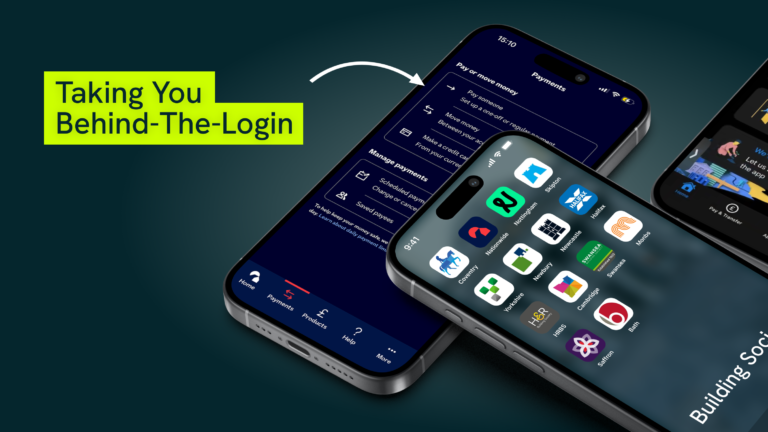
Visibility. Behind-the-login.
Many financial experiences live within logged in experiences, inside personalised journeys that are difficult to see, benchmark or evaluate.
Without this, internal team narratives often fill the gap:
- A single anecdote from a senior stakeholder can become a multi-year truth
- A competitor story can circulate long after the product itself has changed
- The HiPPO effect quietly shapes strategy (The Highest Paid Person’s Opinion)
I’m sure many of us will have experienced this.
Meanwhile, digital teams can be often expected to deliver transformation while operating in organisations where perceived position remains misaligned with digital strategy.
This creates a costly gap between perception and reality.
What actually helps
The product leaders shared several approaches that consistently help bring clarity:
Watch how customers interact
- Usability testing, particularly when senior stakeholders observe real users, is often transformative.
- Nothing survives first contact with a real customer.
- Leaders quickly recognise that they are not the typical user.
Start with problems, not solutions
- Teams that define clear problem statements are better able to measure outcomes.
- Without clarity on the problem being solved, “Best-in-Class” becomes subjective.
Anchor claims in evidence
- Evidence must come from customers’ own experiences and performance metrics, not internal narratives.
- Outcome-based measures, behavioural insight and comparative benchmarks all help to anchor discussions in reality.
Look Behind-the-Login
- Understanding the real customer experience requires analysing what happens inside authenticated journeys.
- This is where you uncover the truth about how you really compare.
Finding your class is key
A key takeaway for me:
Before claiming to be Best-in-Class, organisations must decide which class they belong to.
- Select your class
- Focus on comparable features
- Specify the user
- Evidence the impact
- Then keep raising the bar
And of course, Best-in-Class is never a permanent label. It’s a position that must be continually earned.
How does your mobile experience compare?
BehindLogin combines competitor intelligence with UX guidance to deliver market advantage. Arrange a call to learn how we can help you with our Custom Research.
For more content like this, please sign up for regular emails below.